California state income tax
One formula instead of ten brackets
Today California taxes income in ten steps, like a ladder. This page is both an open simulator and a plain-language proposal: replace the ladder with one smooth, CPI-indexed formula, close the “buy, borrow, die” loophole on loans against unrealized gains, and test the real tradeoffs — top rate vs. base width, behavioral responses, W-2 vs. capital impact, and recession volatility — before generating a letter tuned to your own settings.
Rate on your next dollar 2026 FTB brackets vs. the proposed formula
Behavioral response & migration stress test move beyond static scoring
Taxable income, log scale (each mark is ten times the last). Today's brackets use the official Franchise Tax Board October 2026 rate schedules (Schedule X single, Schedule Y joint, plus the 1% Prop. 63 mental health tax above $1 million). Revenue uses FTB tax-year 2022 class data scaled to the LAO's $149.6B 2028–29 PIT forecast. Default broad-base settings (30% and $265,000) raise ~$50.8B static and retain ~$38.9B even at ETI 0.25 — $6.1B more behavioral resilience than 38% / $450,000 while keeping the combined top rate 8 points lower.
Who pays more, who pays less average change in state income tax per return, by income class
Hover over or tap a bar for details.
In the “by number of returns” view, each bar is as wide as its share of California's 17 million tax returns, so you see how many people each change touches. In the “by income” view, bars sit on an income scale like the chart above. Bar height uses a log scale so both a $1,000 cut and a $1 million increase stay visible. Figures are averages for each FTB income class (tax year 2022, adjusted to current dollars).
W-2 wages vs. capital income — and how high-earning professionals fare live breakdown at current settings
Loading breakdown...
| Example taxpayer (taxable income) | Today (CA) | Proposed (CA) | Change / yr | Effective CA | Marginal CA | Fed + CA marg. |
|---|
Notice the core tradeoff raised by physicians, engineers, and lawyers: raising the halfway income (M) shields salaried W-2 earners in the $250k–$650k range, but requires a steeper top rate (R) on $1M+ returns — or pairing the schedule with the separate borrowed-gain loan tax to reach ultra-wealthy asset holders who report low W-2 wages.
The formula
rate on next dollar = 30% × income ÷ (income + $265,000)
Total tax works out to top rate × (income − halfway × ln(1 + income ÷ halfway)), so the Franchise Tax Board can still print a lookup table for paper filers. Joint filers use $530,000 (2 × halfway income).
Two numbers set the whole tax. There are no steps or flat stretches (today's 9.3% bracket stretches from $75,197 to $384,109 single), so a raise never jumps you into a sudden bracket cliff. Low-income earners pay almost nothing. The rate climbs smoothly through the upper-middle range and slowly approaches the top rate only at very high incomes.
Keeping up with prices
Today the state adjusts each bracket every year for inflation, using the California Consumer Price Index from June to June (3.4% for 2026). With the formula, the state adjusts only one number: the halfway income.
halfway income this year = $265,000 × (CCPI this June ÷ CCPI June 2026)
Because the formula only uses income divided by the halfway income, moving that one number shifts the whole ramp at once. If prices rise 3%, the halfway income becomes $272,950, and someone whose pay also rose 3% pays the exact same share as before. The top rate never changes unless lawmakers or voters change it. Lawmakers could alternatively tie the halfway income to California median wages so real wage growth does not slowly push households up the ramp.
Where the money comes from, and where it goes billions of dollars a year at the current settings
The left side shows the extra tax paid by income classes that pay more. The right side shows where it goes: first the tax cuts for everyone who pays less, then the needs listed below and stabilization reserves.
What it pays for
Even after this year's budget, the Legislative Analyst's Office expects California to spend $8 billion to $10 billion a year more than it collects through 2029–30. The federal H.R. 1 law also shifts food aid and health costs to the state. Keeping CalFresh food benefits whole costs about $4 billion a year, and undoing the planned Medi-Cal cuts to immigrant coverage and community clinics costs about $4 billion more.
- Close the projected operating deficit: about $10 billion a year
- Keep CalFresh food aid whole: about $4 billion a year
- Restore Medi-Cal coverage and clinic payments: about $4 billion a year
- Build 90,000 more affordable homes a year (dedicated fund): about $15 billion a year
- Make public college debt-free (dedicated fund): about $4.5 billion a year
- Schools and community colleges (Prop. 98 mandate): about $12 billion a year
- Boom-year surpluses above $49.5B: locked into a dedicated Budget Stabilization Reserve (Rainy Day Fund) to cushion market downturns
- Total recurring program need: about $49.5 billion a year
Over ten years, 900,000 more homes would mean about 6% more homes in the state. Based on the Legislative Analyst's estimates, that would leave rents about 3% lower and home prices about 7% lower than otherwise. For a renter paying the median California rent of $2,104 a month, that is about $760 a year saved.
Debt-free college would pay what resident undergraduates at community colleges, Cal State, and the University of California still owe for tuition and living costs after federal grants, a family contribution, and part-time work. The Legislative Analyst estimated this at $3.3 billion a year in 2017, about $4.5 billion in today's dollars, with about two-thirds going to community college students.
Recession volatility & stabilization reserve how today's PIT vs. your current settings behave in booms and crashes
California's budget already swings sharply with equity markets because capital gains and stock compensation concentrate at the top. A steeper top-heavy schedule amplifies those swings, whereas a broader base moderates them. To keep recurring programs solvent through recessions, boom-year surpluses above $49.5B must be banked automatically into a dedicated stabilization reserve (or capital-heavy programs like housing construction can pace spending over multi-year cycles).
| Market scenario (LAO historical patterns) | Today's PIT | Proposed PIT | Swing vs. baseline | Extra vs. today | vs. $49.5B need |
|---|
Gains you borrow against — with tighter guardrails
Ultra-wealthy households often avoid realizing income by holding appreciated stock or real estate, borrowing against it to fund spending, and passing the assets on at death when capital gains disappear. Treating large asset-backed loans as realized gain reaches capital wealth directly without raising W-2 wage rates further — but only if loopholes are closed up front:
- Deemed realization above an exemption: When you borrow against appreciated stock, private equity, crypto, or real property, loan proceeds above $250,000 per person per year ($500,000 joint, indexed with M) count as California income up to your untaxed gain in the pledged asset.
- Primary-residence mortgage cap (blocks real-estate hoarding): Standard mortgages on a single owner-occupied primary residence are exempt up to a statutory principal cap (for example, $2 million). Second homes, raw land, and investment properties are NOT exempt — preventing wealthy borrowers from shifting collateral from stocks into hoarded California real estate to recreate the loophole.
- Ordinary consumer credit excluded: Student loans, standard auto loans, and regular credit cards are excluded.
- Basis step-up ledger (no double taxation): Every dollar taxed on a loan increases your California tax basis in that asset, recorded with the FTB, so you never pay state tax on that same gain again when you eventually sell.
- Move-out and lender rules: Loans taken while a California resident (or secured by California-situs property) remain reportable; if a borrower later moves out of state before selling, California basis tracking credits the prior tax paid against any California-source gain, while anti-abuse lookback rules address short-term domicile shifts made right before borrowing.
This follows the deemed-realization option studied by the Yale Budget Lab for federal reform. California already taxes realized capital gains as ordinary income, so counted loan amounts pass through the same formula.
Legal & ballot FAQ (Propositions 40 & 42)
Voters rejected Proposition 40 and approved Proposition 42 on November 3, 2026. Is this allowed?
Rate formula (Requests 1 & 2): Yes. Proposition 42 bars new state taxes on the ownership of personal property (such as stocks, retirement holdings, and savings) and certain retroactive taxes. It does not restrict California's personal income tax schedule, which the Legislature can amend by a two-thirds vote (or voters by ballot initiative).
Loan realization (Request 3): Legally distinct, but faces real court scrutiny. Taxing a loan taken after enactment as a realization event is structured as an income tax on accessing cash from appreciated assets — not an annual tax on owning wealth. However, opponents would almost certainly challenge it under Proposition 42's ban on asset-ownership taxes and its ban on retroactive taxes based on prior conduct. To minimize constitutional risk, Legislative Counsel and the FTB should evaluate limiting deemed realization strictly to prospective loans and, if required under Prop. 42, prospective post-enactment appreciation, and treat the loan provision as severable from the rate formula.
Why not just tax billionaires instead of raising rates on doctors, engineers, and lawyers?
That was the exact tension in California's 2026 ballot debate. Pure state-level wealth taxes were rejected via Prop. 40 and restricted by Prop. 42, while state personal income taxes can only reach realized income (plus potentially realized loan proceeds). Use the Base width ↔ Top rate slider and the W-2 vs. capital breakout table above to see the tradeoff directly: moving M higher protects salaried W-2 households up to $500k+ joint, while moving M lower keeps the combined top marginal rate closer to ~65–67% instead of ~75%.
What happens if a borrower pays back the loan, or if the stock later crashes?
Because the taxed amount steps up the borrower's tax basis dollar-for-dollar, selling the stock later at a lower price generates a California capital loss (which offsets future gains under normal rules), and repaying the loan does not trigger any second tax. The rule simply removes the tax-free cash-out advantage of borrowing versus selling.
Try your own household
In Gross income mode, the calculator applies the official 2026 FTB standard deduction ($5,900 single / $11,800 joint) and personal exemption credit ($158 single / $316 joint, phased out above FTB AGI thresholds) to both today's brackets and the proposed formula. Borrowed amounts count only above the annual exemption ($250k single / $500k joint) and up to untaxed gains.
What it means for a monthly budget typical households at the current settings
Gross income using 2026 standard deduction and personal exemption credit. Rent savings assume a renter paying the California median rent of $2,104 a month, about 3% lower once 900,000 new homes are built in roughly ten years; owners would instead see slower home-price growth. Couples use the joint-filer tax schedules (2M).
Why this matters: California first, then the national backdrop
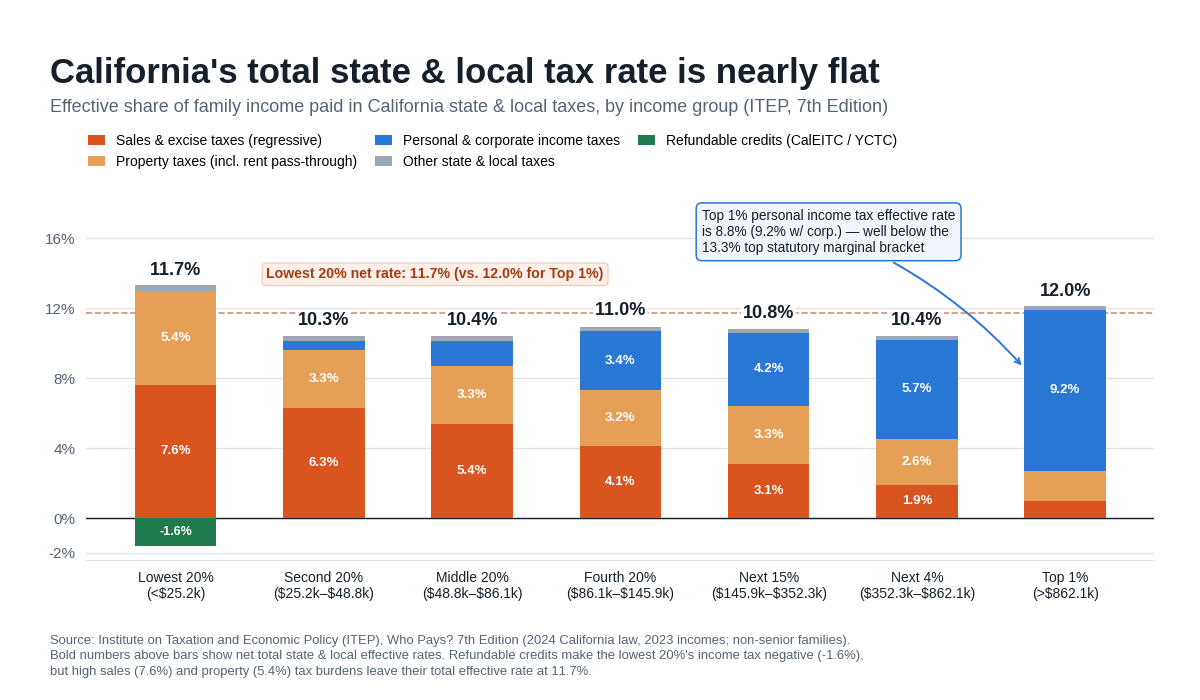
Critics often point to California's 13.3% top marginal bracket to argue that the state's tax system is already maxed out on progressivity. Looking at all California state and local taxes — sales, excise, property, and income combined — tells a more nuanced story: the bottom fifth of California households already pay 11.7% of their income in state and local taxes, almost identical to the 12.0% paid by the top 1%. Meanwhile, because effective rates lag well behind top statutory brackets and unrealized capital gains escape income tax altogether, cutting middle- and lower-income income taxes while smoothing the ramp upward addresses both sides of that imbalance.
What critics say — and where the real tradeoffs lie
California already has the highest statutory top state income tax rate in the nation. Serious objections deserve straight answers rather than hand-waving:
- Out-migration and behavioral response (Laffer-curve risk): Mobile high-income professionals (physicians, attorneys, executives) and business owners can relocate, shift compensation, or work fewer hours if combined federal+state marginal rates climb toward 70–75%. Use the ETI and migration sliders above to see exactly how fast revenue erodes at steeper top rates — and why a broader-base setting like 30% / $265k is far more resilient than 38% / $450k.
- High W-2 earners vs. ultra-wealthy asset holders: Salaried professionals in high-cost metros already pay the highest effective tax rates, whereas billionaires hold unrealized equity. Raising M eases pressure on $250k–$650k W-2 households, while the borrowed-gain rule targets untaxed capital — though enforcing loan realization at the state level faces Prop. 42 legal risk and valuation complexity.
- Revenue volatility in downturns: Relying heavily on top-bracket capital gains already causes wild California budget swings. Any reform that increases progressivity should pair recurring commitments with an automatic stabilization reserve funded by boom-year surpluses, as modeled in the stress test above.
- Spending efficiency & construction capacity: Scaling subsidized affordable housing nearly fivefold requires streamlined permitting and adequate construction capacity so new funds build homes instead of bidding up per-unit costs.
Sources: FTB Tax News October 2026 (official 2026 brackets, standard deductions & credits), FTB on CPI indexing, ITEP Who Pays? 7th Edition (California), Yale Budget Lab on borrowing against gains, California Budget & Policy Center on migration, LAO 2026–27 spending plan, LAO on H.R. 1 CalFresh changes, FTB income distribution data, LAO on housing costs, California Housing Partnership 2026, Enterprise pipeline brief, LAO on debt-free college.
Send your own letter
The letter below updates live to match your current slider settings (R = 30%, M = $265,000). Fill in every highlighted field before you send it.
- Find your representatives at findyourrep.legislature.ca.gov. Enter your home address and note your Assemblymember and State Senator and their district numbers.
- Look up their Capitol suite numbers and email addresses in the Secretary of State's rosters for the Assembly and the Senate. Assembly addresses usually look like assemblymember.lastname@asm.ca.gov, and Senate addresses like senator.lastname@senate.ca.gov, but check the roster.
- Copy the letter into your email program and replace each highlighted field. If your Assemblymember is Chair Gipson or your Senator is Chair McNerney, delete the duplicate address block. If your own legislator lost the November 3rd election, delete the congratulations sentence.
- Add one or two sentences of your own about how taxes, food aid, health coverage, or housing costs affect you. A personal line gets more attention than a form letter.
- Save the figures in the letter (right-click or long-press each image, or click Download current curve PNG below if you changed the sliders) and insert them inline or attach them.
- Email it to your two legislators and the two committee chairs, and copy the Governor's staff, using the lists below.
- Paste the text into the Governor's form at gov.ca.gov/contact, which accepts no attachments, and into Governor-Elect Becerra's form at xavierbecerragovernor.com/contact-us.
- For extra weight, print the letter from your email program and mail it to the Capitol addresses shown.
Committee chairs are reassigned when the Legislature reorganizes in December 2026. Before sending in 2027, check the Assembly and Senate Revenue and Taxation committee pages.
Subject line
Constituent request: replace income tax brackets with one indexed formula and tax borrowing against unrealized gains
To (add your own two legislators)
assemblymember.gipson@asm.ca.gov, senator.mcnerney@senate.ca.gov
Cc
nathan.barankin@gov.ca.gov, christine.aurre@gov.ca.gov, joe.stephenshaw@dof.ca.gov
[Your full name]
[Street address]
[City], CA [ZIP]
[Your email]
[Your phone number]
[Date]
The Honorable [Your Assemblymember]
Member, California State Assembly, [number] District
1021 O Street, Suite [number]
Sacramento, CA 95814
Email: [assemblymember email]
The Honorable [Your State Senator]
Member, California State Senate, [number] District
1021 O Street, Suite [number]
Sacramento, CA 95814
Email: [senator email]
The Honorable Mike A. Gipson
Chair, Assembly Committee on Revenue and Taxation
Member, California State Assembly, 65th District
1021 O Street, Suite 6210
Sacramento, CA 95814
Email: assemblymember.gipson@asm.ca.gov
The Honorable Jerry McNerney
Chair, Senate Committee on Revenue and Taxation
Member, California State Senate, 5th District
1021 O Street, Suite 6640
Sacramento, CA 95814
Email: senator.mcnerney@senate.ca.gov
The Honorable Gavin Newsom
Governor of California
Nathan Barankin, Chief of Staff, nathan.barankin@gov.ca.gov
Christine Aurre, Legislative Affairs Secretary, christine.aurre@gov.ca.gov
Luke Reidenbach, Chief Deputy Legislative Secretary (Revenue and Taxation)
Joe Stephenshaw, Director of Finance, joe.stephenshaw@dof.ca.gov
1021 O Street, Suite 9000
Sacramento, CA 95814
ALSO BY ELECTRONIC COPY TO gov.ca.gov/contact
The Honorable Xavier Becerra
Governor-Elect of California
BY ELECTRONIC COPY TO xavierbecerragovernor.com/contact-us
Re: Request for legislation replacing the personal income tax brackets with a single indexed rate formula and taxing borrowing against unrealized gains
Dear Assemblymember [last name], Senator [last name], Chair Gipson, Chair McNerney, Governor Newsom, and Governor-Elect Becerra:
Congratulations on your and your coalition's victory in the November 3rd election! I am a constituent of Assemblymember [last name] and Senator [last name] in [City], and I respectfully ask each of you to introduce, co-author, and support legislation in the 2027–28 session that makes three changes to the California personal income tax, paired with a budget stabilization reserve. I would also ask the Governor's office and the incoming administration to request dynamic estimates from the Franchise Tax Board and the Legislative Analyst's Office so the parameters can be calibrated before introduction.
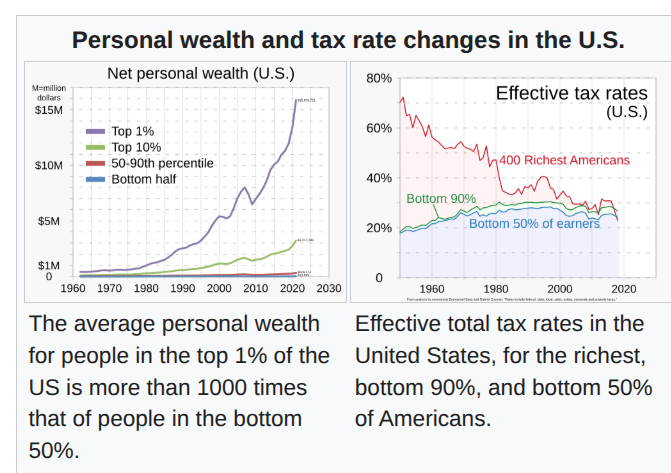
The problem. Although California's personal income tax has a 13.3 percent top marginal bracket, the Institute on Taxation and Economic Policy (Who Pays? 7th Edition) finds that once regressive sales and property taxes are included, California's combined state and local tax system is nearly flat: the lowest 20 percent of families pay 11.7 percent of their income in total state and local taxes, compared to 12.0 percent for the top 1 percent (whose actual effective personal income tax rate is 8.8 percent, see Figure 1). Nationally, economists Emmanuel Saez and Gabriel Zucman show a similar long-term trend in total effective tax rates alongside rising wealth concentration (Figure 2). Meanwhile, California's ten income tax brackets are unevenly spaced — the 9.3 percent single-filer bracket runs from $75,197 to $384,109 in 2026 — and the 10.3 to 12.3 percent rates face expiration after 2030 unless lawmakers or voters act.
|
Figure 1. California combined state and local effective tax rates by income group (ITEP, Who Pays? 7th Edition). |
|
Figure 2. National context: U.S. wealth and total effective tax rates (Wikipedia; Emmanuel Saez and Gabriel Zucman). |
Request 1: One continuous rate formula in place of the brackets. I propose (see Figure 3) that the marginal rate on each additional dollar of taxable income y be:
rate = R × y ÷ (y + M)
Here R is the top rate and M is the "halfway income," where the rate is half of R. Total tax has an exact closed form, R × (y − M × ln(1 + y ÷ M)), so the FTB can still publish lookup tables. Joint filers use 2M, matching current practice. With R = 18 percent and M = $155,000, the formula is roughly revenue-neutral. To meet the state needs below while balancing base width against top-rate behavioral risk, I propose R = 30 percent and M = $265,000 (joint halfway $530,000). Under these settings, single filers with taxable income below about $189,000 (about $378,000 for joint filers) pay less state income tax than today: about $4,547 instead of $5,618 at $100,000 taxable income. Filers above that pay more: about $175,734 instead of $103,185 at $1 million, and about $2,709,287 instead of $1,300,185 at $10 million. I ask that the FTB and LAO score these settings dynamically — including behavioral elasticity and migration — before introduction.
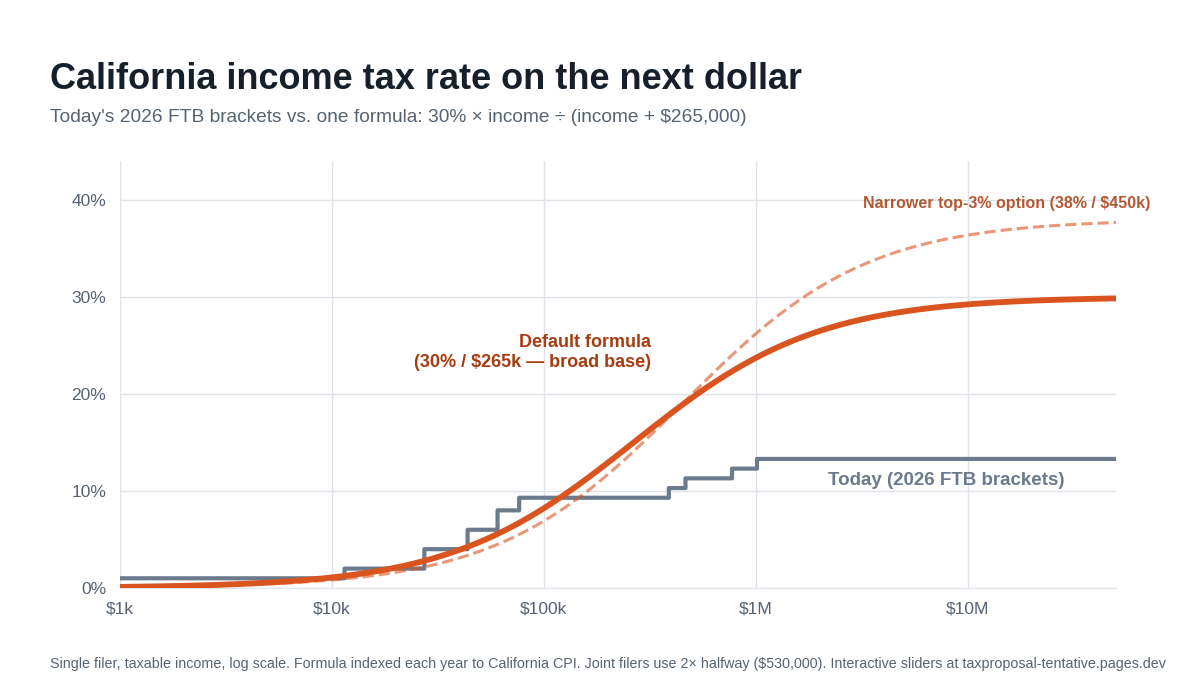
Figure 3. California tax rate on the next dollar, today (2026 FTB brackets) and under the proposed formula (default broad-base setting R = 30%, M = $265,000, with the narrower 38% / $450,000 option dashed). |
Request 2: Automatic indexing of one number. Each year, M would be multiplied by the June-to-June California Consumer Price Index ratio that the FTB already uses for bracket indexing. Because the formula depends only on y divided by M, this single adjustment keeps the whole schedule constant in real terms. The rate R would change only by legislation or vote. I would also welcome analysis of indexing M to California median wages instead.
Request 3: Tax gains that are borrowed against (with anti-loophole guardrails and Prop. 42 review). Many ultra-wealthy households avoid tax by holding appreciated stock or real estate and living on loans against those assets. I propose treating prospective loans secured by appreciated assets as realizing gain up to the borrower's untaxed gain above an indexed annual exemption of $250,000 per person ($500,000 joint). Student loans, auto loans, credit cards, and mortgages on a single owner-occupied primary residence up to a statutory principal cap (such as $2 million) would be excluded; investment properties and second homes would not be excluded so borrowers cannot simply shift collateral into hoarded real estate. Taxed amounts would step up California basis dollar-for-dollar in an FTB ledger so gains are never taxed twice, paired with part-year and move-out reporting rules. Recognizing that voters rejected Proposition 40 and approved Proposition 42 on November 3, 2026, I ask Legislative Counsel to ensure this provision applies strictly prospectively to post-enactment borrowing (and post-enactment appreciation if constitutionally required) and is drafted as severable from Requests 1 and 2.
What this would pay for — and protecting against recessions. Even after this year's budget, the LAO projects operating deficits of $8 billion to $10 billion a year through 2029–30, before offsetting federal H.R. 1 cost shifts in CalFresh (~$4 billion a year) and Medi-Cal immigrant coverage and clinic cuts (~$4 billion a year). Dedicated funds of $15 billion a year for 90,000 additional affordable homes and $4.5 billion a year for debt-free public college, alongside about $12 billion a year for schools and community colleges under Proposition 98, bring the recurring target to $49.5 billion a year:
| Close the projected operating deficit | $10 billion |
| Keep CalFresh benefits whole | $4 billion |
| Restore Medi-Cal immigrant coverage and clinic payments | $4 billion |
| Build 90,000 more affordable homes each year (dedicated fund) | $15 billion |
| Make public college debt-free (dedicated fund) | $4.5 billion |
| Schools and community colleges (Prop. 98 mandate) | $12 billion |
| Boom-year surpluses above target | Stabilization reserve |
| Recurring new revenue target each year | $49.5 billion |
Applying R = 30 percent and M = $265,000 to the FTB's tax-year 2022 income distribution (scaled to the LAO's $149.6 billion 2028–29 PIT forecast) raises roughly $50.8 billion statically (about $38.9 billion under a mid-consensus behavioral elasticity of 0.25), excluding any additional revenue from taxing borrowed gains under Request 3. Because California's personal income tax swings sharply with equity markets, I propose automatically depositing boom-year surpluses above the program target into a dedicated budget stabilization reserve so core services remain protected in downturns.
Concerns I take seriously. Opponents rightly note that higher top rates create migration and income-shifting risk (with a combined federal+state top marginal rate near 67 percent at R = 30%), that salaried W-2 professionals in high-cost metros already bear steep marginal rates, that a loan-realization rule faces valuation challenges and Proposition 42 litigation risk, that top-heavy revenue increases recession volatility, and that scaling subsidized housing construction requires permitting reform and workforce capacity. I ask that the LAO analysis address each of these directly, compare broad-base vs. narrow-top parameter pairs, and phase new rates in over two years so behavioral responses can be measured.
Chair Gipson and Chair McNerney, I respectfully ask that your committees hold an informational hearing on these proposals early in the 2027–28 session, with testimony from the FTB, LAO, and Legislative Counsel.
Governor-Elect Becerra, during the campaign you pledged to review tax code changes to offset federal health care cuts. I hope you will include this proposal in that review. Governor Newsom, I ask that your office help the incoming administration by requesting the FTB and Department of Finance estimates now, before the 2027–28 budget is drafted.
An interactive simulator with presets, a base-width vs. top-rate slider, behavioral elasticity and migration controls, recession stress tests, and a single/joint household calculator is available here: California Tax Ladder.
Thank you for your consideration. I would be glad to meet with your staff and would appreciate a written reply stating your position.
Respectfully,
[Your full name]
Constituent, Assembly District [number] and Senate District [number]
[Your email]
[Your phone number]